
Leveraging AI for Parents: How to Use It Wisely Without Replacing an Advocate or Attorney
Artificial intelligence can be a powerful support tool for parents navigating special education—but only when used appropriately. This guide explains how AI can help with organization, documentation, and preparation, while clarifying why it should never replace a trained advocate or attorney when legal rights, strategy, and accountability are on the line.

Why DMV Parents Must Attend the COPAA Conference
DMV parents don’t need more opinions — they need clarity. The COPAA Conference equips families with the legal insight, documentation strategy, and advocacy tools necessary to navigate IEPs and 504 plans effectively.
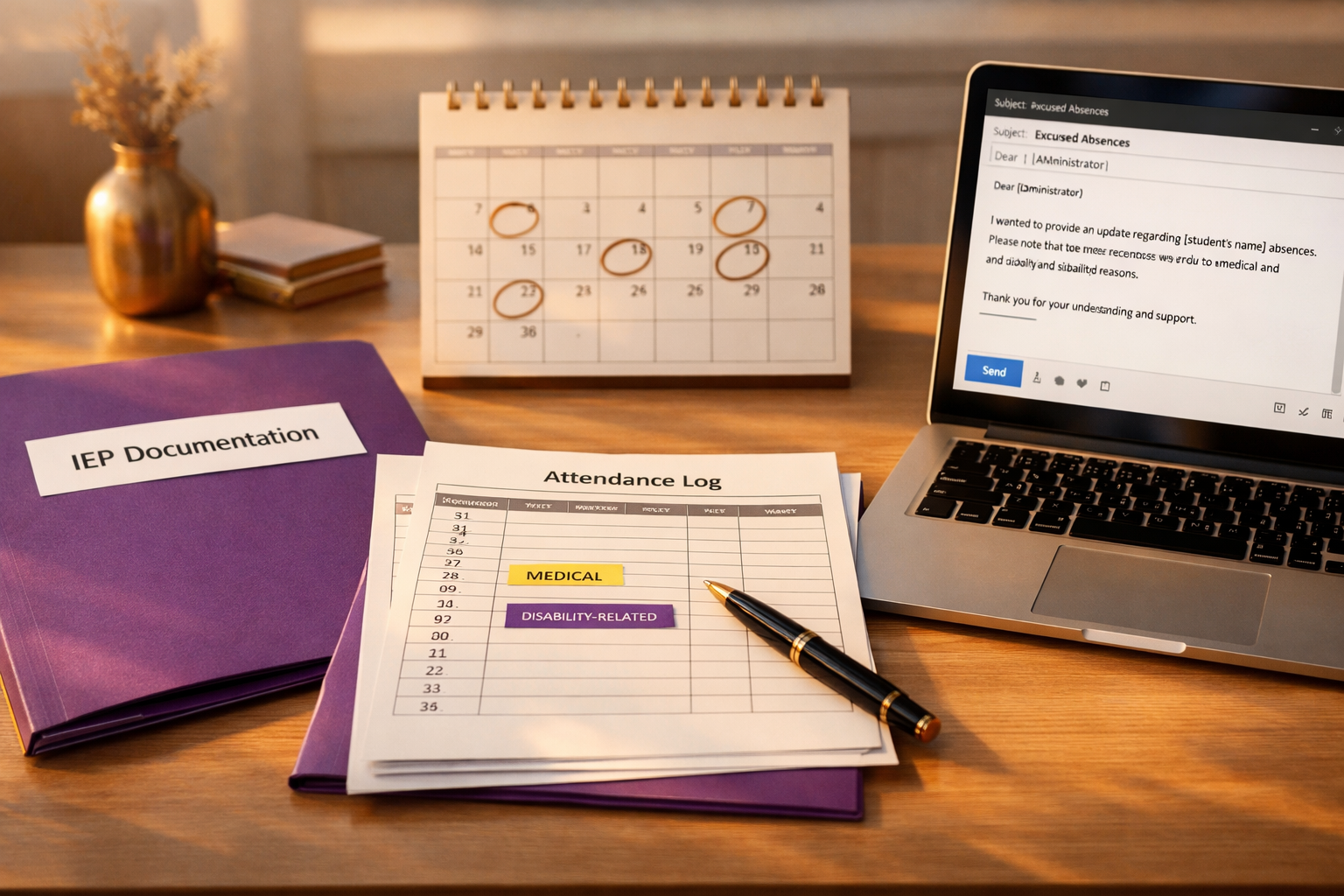
Why You Must Document Disability-Related Absences and Tardies
Disability-related absences and tardies are not attendance problems — they are access issues. When schools fail to properly document these patterns, families are often blamed, services are delayed, and legal protections quietly erode.
This post explains why consistent documentation matters, how it connects to IEP and 504 protections, and what families must do to protect themselves when attendance is impacted by disability, medical needs, or school-based failures.

What We Built in 2025 — And Why It Matters Going Into 2026
Families navigating IEPs and 504s are too often left to figure it out alone. 2025 was my answer to that gap: build tools, language, and structure that reduce overwhelm and increase results. This post breaks down what was built—and what it unlocked for 2026.

School Avoidance Is Not Truancy: What Parents and Schools Get Wrong
School avoidance is rarely resolved with one email or one meeting.
For IEP and 504 families, it requires ongoing documentation, strategy, and informed advocacy.
The IEP Files Academy is an educational program designed to help parents understand their rights, organize documentation, and advocate effectively within the special education system.

Key IDEA Laws and Landmark Cases Every Parent Must Know (Maryland & Georgia Edition)
Special education rights are not based on opinions or school discretion—they are grounded in federal law and reinforced by decades of court decisions. This guide highlights the most important IDEA provisions and landmark cases every parent in Maryland and Georgia should understand to advocate effectively, recognize violations, and hold school systems accountable.

Why the COPAA Conference Matters — and How the Beth Goodman Scholarship Can Get You There
Advocacy is stronger when parents understand the law, the system, and how to use both strategically. The COPAA Beth Goodman Scholarship helps advocates attend the COPAA Conference — a rare space where parents, advocates, and attorneys learn together. With the conference being local this year, access matters more than ever. Applications are due January 16, 2026.

What the Spoon Theory Teaches SPED Moms (and Our Kids) About Energy
Spoon Theory gives language to something SPED moms live every day: energy is finite. Understanding this framework helps parents model boundaries, make intentional choices, and teach children that honoring their limits is not a weakness—it’s a skill essential to lifelong self-advocacy.

Parent Power: My Amazon Book + Tool List for Advocacy, Boundaries & Support
Parenting a child with an IEP, dyslexia, or autism isn’t easy—especially when schools throw jargon and red tape your way. Over the years, I’ve built an “advocacy shelf” of books and tools that keep me prepared for meetings, help me support my child’s learning, and remind me to protect my own peace.
This Amazon list is packed with my must-have resources: Wrightslaw guides for IEP law, Orton-Gillingham workbooks for reading, autism SEL activities, and even boundary + healing guides for parents. These are the receipts that changed the game for me—and they can do the same for you.

No Parent Alone: The Movement Parents Have Been Waiting For
For too long, parents have been walking into IEP meetings by themselves — overwhelmed, unheard, and outnumbered. Schools bring teams of administrators, specialists, and lawyers. Parents bring… themselves.
That ends now.

Advocacy With Receipts: How to Walk Into IEPs Prepared
Parents don’t lose IEP meetings because we don’t care. We lose because the system counts on us showing up without receipts.
An IEP isn’t about how nice your child’s teacher is or how many times you’ve emailed the principal. It’s about data, documentation, and demands. That’s how you make the law work for your child.


Why Families of Color Need to Know About the Endrew F. Case
What Happened in Endrew F.
Endrew was a child with autism. His school kept recycling the same IEP goals year after year, and he wasn’t making progress. His parents pulled him out and demanded more.
The district argued that IDEA only required “some educational benefit” — the lowest possible bar.
In 2017, the U.S. Supreme Court disagreed. They set a new, higher standard:
An IEP must be “reasonably calculated to enable a child to make progress appropriate in light of the child’s circumstances.”
This ruling is binding on every district in the country.

The Top 4 Wrightslaw Books Every Special Needs Parent Should Own
When you’re navigating the IEP process, information is power — and no one equips parents with better tools than Wrightslaw. Their books break down special education law in plain English and give you strategies you can use at the IEP table tomorrow.
Here are the four Wrightslaw books I recommend to every parent I work with, and why they deserve a spot on your shelf.

Understanding the 13 IDEA Disability Categories (and How to Protect Your Child’s Rights)
If your child struggles in school, one of the first questions you’ll face is:
“Does my child qualify for special education under IDEA?”
The Individuals with Disabilities Education Act (IDEA) defines 13 categories of eligibility for students ages 3–21. But the process isn’t simple:
Schools often misinterpret or misuse the definitions to deny services.
Some states (like Iowa) impose additional exclusions or tests not in federal law.
Many parents aren’t told they can list multiple disabilities (primary and secondary) to ensure full support.
Here’s everything you need to know, with references to federal law and state rules, plus language to use when schools try to block you.

The Ultimate Guide to IEPs and 504 Plans: What Every Parent Needs to Know (and What Schools Don’t Tell You)
If your child is struggling in school—academically, behaviorally, or socially—you’ve probably heard the terms IEP and 504 Plan.
But most parents, especially in our communities, are never told how these systems really work—or how schools use our lack of knowledge to cut services, delay help, or deny our children what they’re entitled to by law.
This guide will break it down in plain language:
What an IEP or 504 Plan is (and why your child might need one)
How to get one (even when the school stalls)
What to do once you have one—from day one through high school graduation
What your procedural safeguards really mean (and why you must read them)
How to document, escalate, and fight back when the school refuses to follow your child’s plan
And a step-by-step checklist so you can take action immediately

Parent Escalation Checklist: When to Take Your Fight Up the Ladder
Step 1: Before Escalation – Gather Your Evidence
Make sure you have the following in one folder (digital or binder):
Copies of your child’s current IEP or 504 Plan (and all past versions)
All evaluation reports (school and independent)
Progress reports and service logs (speech, OT, PT, academic supports)
Emails and meeting notes (documenting requests, refusals, and responses)
Any Prior Written Notices (PWN) the school has issued—or proof they failed to provide one (34 C.F.R. §300.503 requires it)
Behavioral data (incident reports, suspension letters, behavior plans)
Your log of missed services or noncompliance (dates, times, staff)

From IEP to Injustice: How Parents Can Stop the School-to-Prison Pipeline
For far too many children—especially Black and Brown students—the path from the classroom leads not to college or careers, but to courtrooms and incarceration.
This is called the School-to-Prison Pipeline, and if your child has an IEP or should have one, they’re at even greater risk.
Why?
Because when schools deny evaluations, ignore data, fail to provide appropriate learning, and keep parents in the dark, our kids don’t just fall behind—they’re punished for struggling, suspended, expelled, and often funneled into the juvenile justice system.
But it doesn’t have to be this way.

Maryland Families: How Mediation Can Get Your Child’s IEP Back on Track
When you and your school disagree about your child’s special education services, mediation offers a powerful tool to resolve conflicts without costly litigation. In Maryland, multiple avenues—community mediation centers and the state’s dispute resolution system—can guide you to fair, informed, and legally supported agreements.

Prior Written Notice (PWN): A Parent’s Tool for Clarity and Accountability
What is PWN (and Why Does It Matter)?
If you’ve ever left an IEP meeting feeling unclear about why a decision was made — whether a service was added, changed, or denied — you’re not alone.
That’s where Prior Written Notice (PWN) comes in. PWN is a formal, written explanation from your school district about any decision regarding your child’s identification, evaluation, placement, or services.
It isn’t just paperwork — it’s a tool that ensures:
You understand why a decision was made
You see the data and reasoning behind it
You know what other options were considered